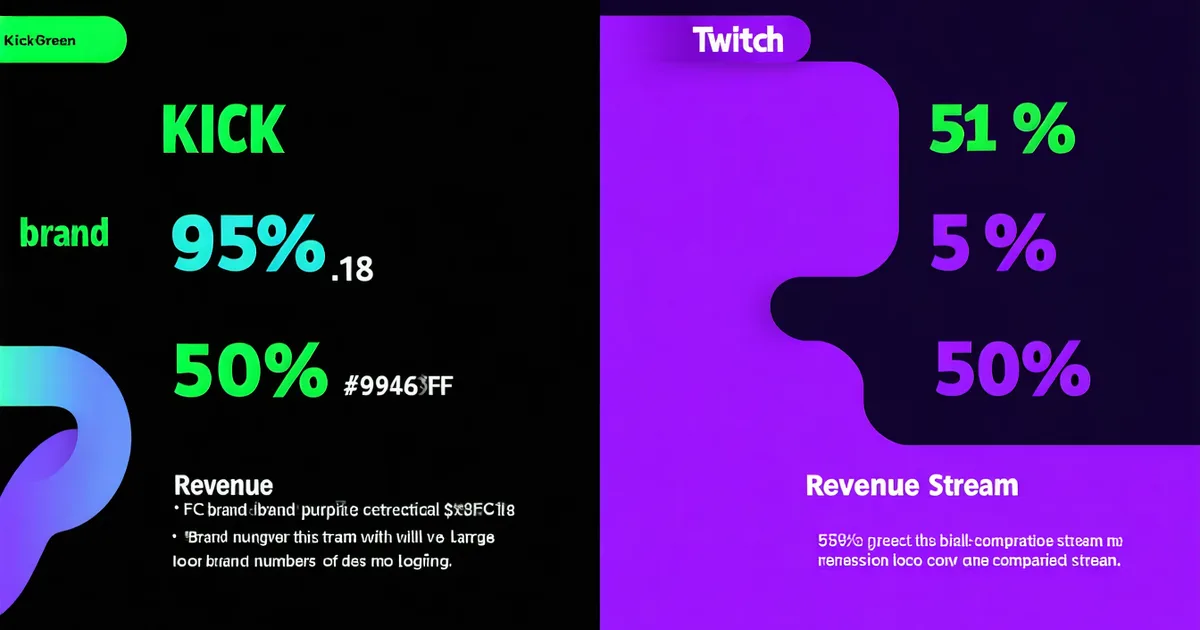
The 95/5 revenue split is the number Kick leads with, and it's real. When a viewer subscribes to your Kick channel, you keep 95% of that subscription revenue. On Twitch, the standard split for most affiliates is 50/50 — meaning a $4.99 sub generates roughly $2.50 for the streamer. On Kick, that same sub price generates roughly $4.74. Across 100 subs a month, that's a difference of approximately $224. At 1,000 subs, it's $2,240 per month. The math is not subtle.
So why isn't every streamer on Kick? The answer is layered, and working through it honestly is more useful than either the "Kick is the future" argument or the "Kick will fail" dismissal. For anyone thinking about where to build their overlay setup and community infrastructure, the practical questions matter more than the platform ideology.
The Discoverability Gap Is Real and Significant
Twitch has a viewer discovery problem — channels in non-featured categories with under 500 average viewers often have difficulty getting organic discovery from the platform's browse pages. But the problem on Kick is currently more severe for most categories. Twitch's recommendation algorithm, as opaque and frustrating as it is, has years of behavioral data and drives a meaningful percentage of new viewer acquisition for growing channels. Kick's recommendation surfaces are thinner.
What this means practically: if you move entirely to Kick with 300 average viewers, you're likely keeping most of your existing community (assuming they follow you there), but organic growth from platform discovery is harder to achieve at this point in Kick's development. Your growth engine becomes your own promotion — clips shared to social platforms, word of mouth, raids from Kick-native channels — rather than any platform algorithm working for you.
This isn't a permanent state. Platforms with better creator economics typically attract creators, which attracts viewers, which eventually creates discovery infrastructure. But the current state in late 2025 is that Twitch still has a substantial discoverability advantage for most categories outside of the largest channels.
Kick API Maturity: What It Actually Means for Your Overlay Setup
This is the part that directly affects overlay tools and interaction mechanics, and it's where the platform comparison gets most concrete for Tangia's use case.
Twitch's API has over a decade of development behind it. EventSub is stable, well-documented, and has clear versioning. The Channel Points API, hype train events, subscription events, raid events — all of these have predictable webhook formats, reliable delivery, and a documented deprecation process (PubSub to EventSub being the most recent major transition). Building interaction tools on top of Twitch's API is challenging mainly because of rate limits and the complexity of managing OAuth flows, not because of fundamental instability.
Kick's API is less mature. We want to be direct about this because it affects what we can reliably promise: Kick's API, as of our experience working with it, is still stabilizing. Endpoint behavior can change, webhook delivery is less consistent than Twitch's EventSub, and the documentation has gaps that require reverse engineering or community knowledge to fill. This isn't a criticism of Kick's engineering team — building a platform-scale API from scratch is genuinely hard — it's an honest assessment of where the tooling is.
"The revenue split is the headline. The API maturity is the infrastructure question. For streamers who care about reliable overlay behavior, they're not the same problem."
What This Means for Tangia on Kick
Tangia supports Kick, and we'll continue to invest in that support as the API matures. But we're transparent with streamers: Kick-side features have a higher likelihood of experiencing edge-case failures that are platform-dependent, not tool-dependent. When Twitch's EventSub relay has a delivery delay, that's a known, documented, occasional event with Twitch's own status page. When Kick's API has an unexpected behavior change, we find out the same way our users do.
For streamers whose primary platform is Kick, we'd recommend testing your overlay setup thoroughly on Kick before a major stream rather than assuming Twitch testing translates directly. The core queue and alert mechanics work, but edge cases — particularly around sub train events and multi-gifted-sub events — may behave differently than on Twitch.
The Case For Multi-Streaming (and the Case Against)
Simultaneous multi-streaming — broadcasting to both Twitch and Kick at the same time using a tool like Restream — is the obvious response to the platform dilemma. You get Twitch's discovery infrastructure and Kick's better economics, run them in parallel, and see which community develops.
The genuine case for it: if you have under 500 average viewers and aren't under a Twitch exclusivity contract, there's limited downside. You're not giving up Twitch discoverability (you're still live on Twitch) and you're building presence on Kick simultaneously. Your overlay setup works the same either way since you're broadcasting from OBS to both.
The case against: community fragmentation. When your Twitch chat and Kick chat are different populations having different conversations about the same stream, neither community fully forms. Raid chains only happen on one platform. Sub trains are separate on each platform. The social fabric of a stream depends partly on everyone being in the same conversation. Split communities tend to grow slower and feel less connected than unified ones. This effect is more pronounced once you're past the early growth phase — streamers with under 200 average viewers may not notice it, but streamers in the 500–1500 range often find that multi-streaming creates two thin communities rather than one strong one.
Platform Dependency Risk
The bigger-picture consideration: putting all your revenue on a single platform is a business risk regardless of which platform it is. Twitch has changed payout structures before (the 70/30 exclusive partner deal being reconfigured in 2023 affected a number of Partners). Kick is newer and less predictable. The streamer who has income spread across subs on one platform, merchandise, sponsorships, and a direct Patreon or membership has a more resilient income structure than one whose 90% of revenue comes from Twitch subs alone.
- Don't let Twitch's algorithm be your only growth engine — clips, Discord community, social short-form, and collabs all compound independently
- If you're on Kick, treat the API as still maturing and test interactions before high-stakes streams
- Multi-streaming makes sense at early community sizes; evaluate the fragmentation cost as you grow
- Revenue diversification away from any single platform's sub split is the most durable position regardless of which platform "wins"
Tangia connects to both Twitch and Kick using their respective public APIs — we don't have any partnership relationship with either platform, just API access. The feature parity between platforms will continue to improve as Kick's API stabilizes. If you're running on Kick and want to test the current state of the integration, the free tier works on both platforms and you'll see quickly where the behavior differences are in practice.